Client work · AI, apps and everything behind them · ongoing
ViziSmart — AI Property Management, End to End
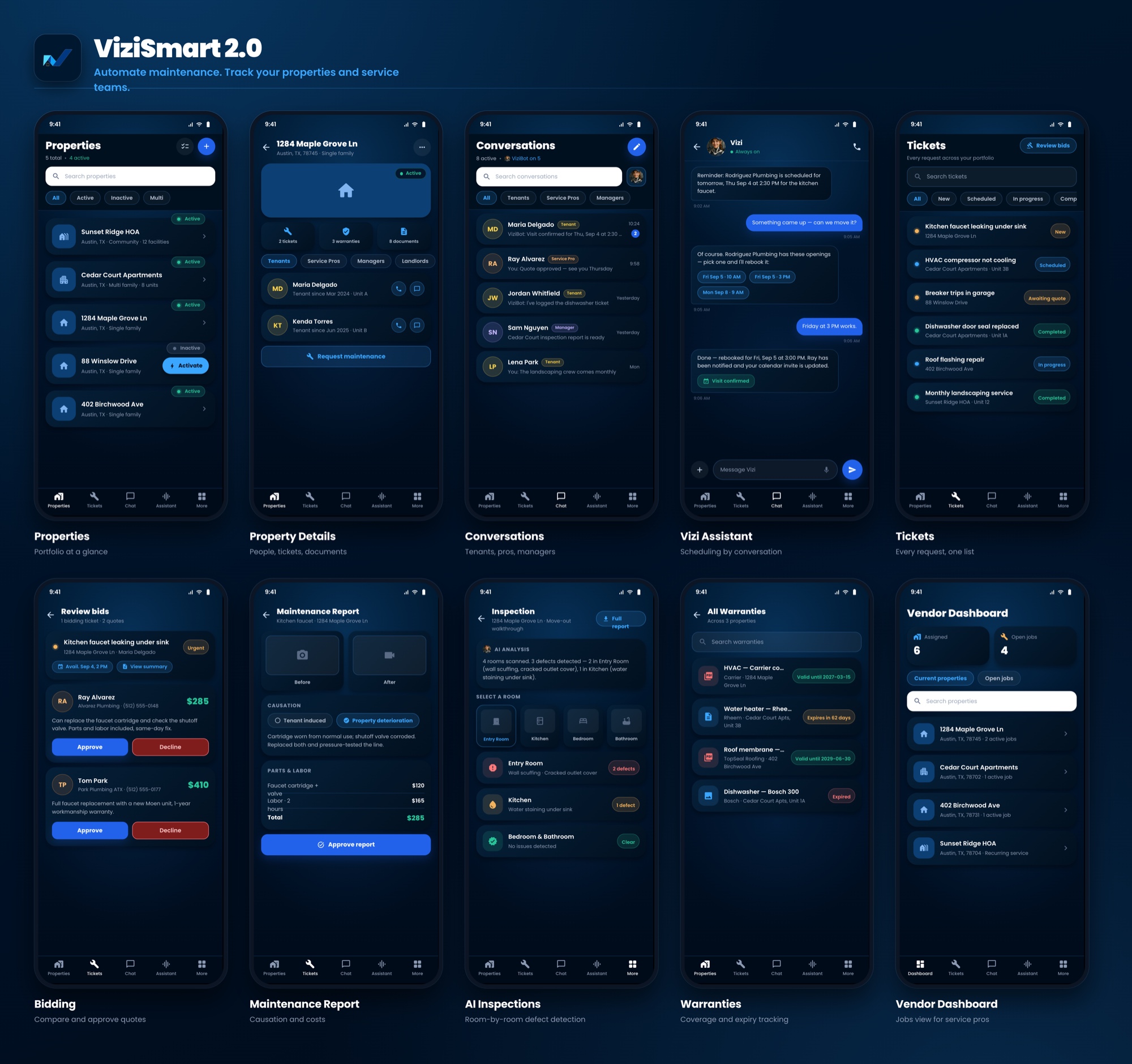
ViziSmart wanted property inspections a manager would actually act on: a walkthrough video in, a room-by-room list of real defects out. The AI had to be dependable rather than impressive, and the rest of the product had to keep shipping while it was built.
- layers owned — app, API, AI, cloud
- 4layers owned — app, API, AI, cloud
- user roles, one system
- 5user roles, one system
- team for app, models and infra
- 1team for app, models and infra
The brief
ViziSmart came to us with an AI-assisted property-management platform and a specific ambition: turn inspection footage into something operational. They wanted defects detected per room, reliably enough that a property manager would act on the result and a tenant would accept it. They also needed the product to reach phones, and they did not want a second team to get there.
What we proposed, and how it ran
01
We started with measurement, not the model
The first thing we built was not the detector — it was the harness that scores it. A golden set of known walkthroughs and an evaluation run mean any prompt or model change is measured against real cases before it reaches a property manager. Without that, every improvement is a guess and every regression is a surprise. This is the decision the rest of the engagement rests on.
02
We made vision a service, not a feature
The detection pipeline runs as its own Python service that turns a walkthrough into structured, validated defects per room. Keeping it separate means it can be evaluated, versioned and scaled on its own, and the product does not inherit the model's failure modes.
03
We put the AI where the work already happens
A defect list is only useful if it becomes work. Inspections feed tickets and warranty records, maintenance reports reason about causation and cost, and scheduling happens conversationally — a tenant asks to move a visit and the vendor gets rebooked in the same thread. The automation sits inside existing workflows rather than beside them.
04
We collapsed web and native into one codebase
Rather than staffing a second mobile team, we built a monorepo where the React web app and the Expo iOS and Android apps share design tokens, a typed API client, and UI. Five user roles ship from one system, and parity between web and mobile is checked rather than hoped for.
05
We took the infrastructure too
Storage, background workers, IAM and the bill. Long-lived keys replaced with instance roles, dev and production storage separated, blocking work moved off the request path, and an audit that found a large share of monthly spend was removable waste.
What we delivered
- A computer-vision inspection service returning room-level defects from walkthrough footage
- An evaluation harness and golden set, so the pipeline can be changed safely
- Conversational scheduling that rebooks vendor visits inside a chat thread
- Maintenance reports with causation analysis and itemised cost
- Inspections wired into tickets, bidding and warranty tracking
- A native iOS app, live on the App Store, and the web app at app.vizismart.com — one monorepo, five roles
- A hardened AWS estate — background workers, scoped IAM, separated environments
Where it stands
Shipped and in active development. The iOS app is live on the App Store and the web app runs at app.vizismart.com. Inspections come back as room-level defects instead of footage, changes to the vision pipeline are validated against a golden set before they ship, and one team runs the app, the API, the models and the infrastructure — including a cloud audit that cut a substantial share of monthly spend.
See it live
Stack
Building something similar?
Tell us the outcome you want. We come back with scope, price and a timeline — usually within a day.